
By: Christopher Geitner ‘27
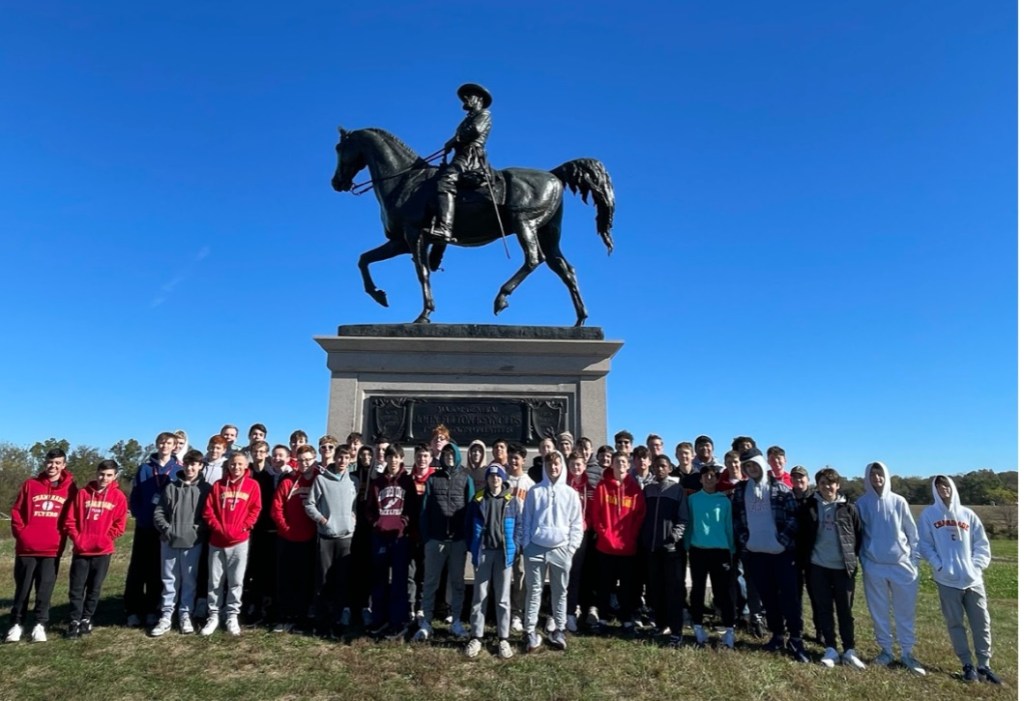
The underclassmen divisions of Chaminade’s Social Studies club made their annual return to Gettysburg National Military Park last Friday, October 19th, as the first of two major trips that the clubs take each year. The trip highlights the importance of the Battle of Gettysburg, and allows students a first hand account of the experiences of soldiers and residents of the area over the course of the battle. Students visit multiple sites in the Gettysburg Battlefield Historic District, with narration and insight provided by Mr. Richard DeMarco ’12. While the trip allows for new experiences and connections between members of the classes, it also serves as a showcase of Chaminade’s commitment to education both in and out of the classroom.
Departing from the Darby Auditorium steps still under the cover of the night, freshman and sophomore social studies club members, as well as moderators Mr. Richard DeMarco ’12 and Mr. Andrew Garcia ’16 made the multi-hour journey to Gettysburg, Pennsylvania. ”Gettysburg”, as the trip has come to be known, is one of two major trips that underclassmen have the option to attend with the social studies club, the other being “D.C.”, the annual visit to our nation’s capital. The trip allows students to experience first-hand the events that took place during the battle, and offers a perspective that won’t be found in a textbook or film.
Throughout the day, the group followed the chronological order of the battle, following both the Union Line and the Confederate Line. Sophomore Chris Covelli ‘28 attended the trip, and detailed how the trip was specifically informative for him. He referred to Mr. DeMarco as “A Great Teacher”, and noted how he learned much more than he could by simply reading a textbook. Covelli noted how the chronological order of the tour helped him understand how the battle transpired, and how it served as the turning point for the war. In addition, he noted the success of the trip, and wished that the opportunity to return again was open to upperclassmen.
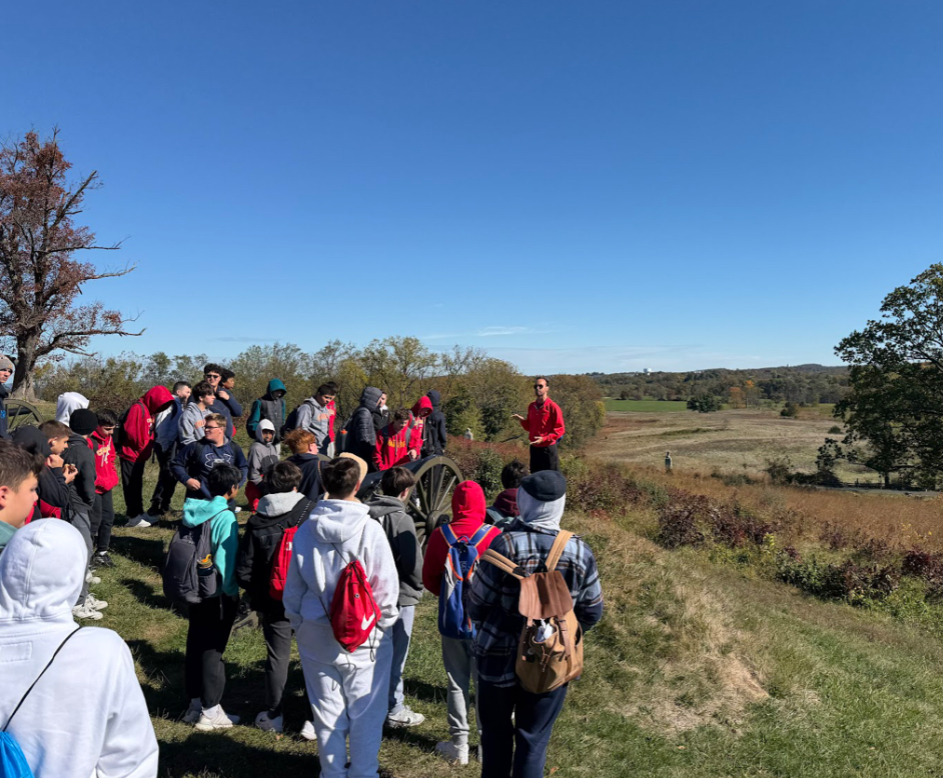
In a later interview, Mr. Demarco described the trip as “fantastic”, noting how everything from the weather to student attitude helped make the day what it was. He also noted how great the views were, as did Mr. Garcia. The benefit of being present to understand the size and scope of the battle was important, noted both moderators. Mr. Garcia noted how common it is for individuals, especially students to underestimate the challenge of the soldiers, and how nature always plays a role. While he was thankful for the good weather, Mr. Garcia noted how rain, mud and cold could offer a different perspective.
The trip began with students following the Union Line from Days one and two of the battle. Accordingly, the trip begins to the south of town, where Union forces retreated to during the initial stages of the battle. Nearby is a cemetery where many soldiers and civil war figures were buried. A monument to Abraham Lincoln is also present in the cemetary. Standing next to the monument, Mr. DeMarco read Lincoln’s Gettysburg Address, one of the shortest yet most well revealed speeches in American History.
The Battlefield is littered with numerous monuments to certain brigades and battalions. The group walked a trail which passed many of these, and paused for lunch at the Pennsylvania Monument. The monument stands out as the largest, requiring stairs to reach the top. Unfortunately, the top was closed this year due to bee and wasp nests, as sophomore William Duffy ‘28 notes. Nonetheless, the Pennsylvania monument, and all the others continue to attract visitors, and have cemented themselves in the Gettysburg Experience.
After passing numerous monuments, the trip headed to Little Round Top and Devils Den. These two locations played an instrumental role in the Union Victory. Both of these locations were the site of heavy fighting on the second day of battle, with the Confederate army fighting to break the left flank of the Union. Despite heavy fighting and casualties, the Union held on to fight another day, forcing the Confederate army to launch a desperate attack attempt known as “Picketts’ Charge” on day three of fighting. Sophomore William Duffy ‘28 noted how the experience of being present at both of these locations helped show the scale of the conflict, and how as a whole the trip was very informative.

Photo courtesy of Chris Covelli ’28.
The climax of the trip is when students re-enact “Pickett’s Charge”, originally a last ditch effort by Confederate forces to penetrate the Union line. The charge was ordered by Confederate general Robert E. Lee, and named after General George Pickett. The charge featured around twelve-thousand men charging over a mile to reach the top of Cemetery Ridge, where a few men made it but were defeated. The charge proved a failure and forced the Confederates to retreat from Gettysburg in the Union Victory. Students re-enacted the charge, although as Mr. Garcia notes, most didn’t make it all the way. Both Chris Covelli ‘28 and William Duffy ‘28 agreed that re-enacting the charge was a favorite for both of them.
All of those interviewed agreed that the trip was a success, including both moderators. With excellent weather and an engaged group of students, the trip gave students an opportunity to get out of the classroom, meet others and learn about American history. Mr. DeMarco’s teaching of the battle was also highly regarded. While upperclassmen were not allowed to attend, their hopes of attending more Social Studies Trips may be honored in the future. Mr. Garcia, moderator of the upperclassmen Social Studies club said in an interview that he, along with Mr. DeMarco was looking into creating a field trip for the upperclassmen. Hopefully the annual success of the Gettysburg trip will allow for more, similar opportunities.

 Tarmac Online
Leave a comment