
By Blake Lou Weaver ’27
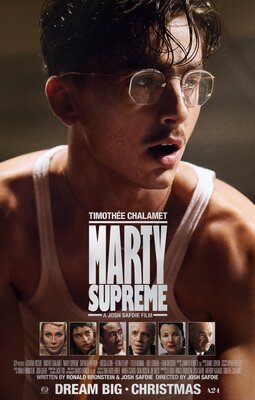
It is hard to think of a recent movie with more hype surrounding it than Timothée Chalamet’s new film Marty Supreme. With an incredible marketing campaign, as well as a star-studded cast, the movie brought in $27.1 million from the box office in its opening weekend. The film has been lauded as “pure cinematic gold” according to IMDb, with others claiming that the film is destined for greatness come the Oscars. Chalamet himself has been reveling in the hype, claiming that the film is his “best work yet.” While the movie is ultimately enjoyable to watch, there are severe flaws in the film that hold it back from being as great as many claim it to be.
The first of these flaws is that the film feels out of place with its time period, which is the 1950s and mostly focused in New York City. This is most evident with the movie’s soundtrack. Rather than include popular music from the ’40s and ’50s, the soundtrack is composed of hits from the ’80s. Many online have claimed that the soundtrack is “exciting” and “exhilarating” and matches the overall plot of the movie. The soundtrack is certainly exciting and in some cases does match the action of the movie quite well; however, for the majority of the time the music is out of place. When “Everybody Wants to Rule the World” plays in the background, one would think that Marty is hustling his way through the 1980s, wearing a pair of acid-washed jeans; however, the viewer is forced to remind themselves that this movie takes place in the 1950s. A soundtrack should transport the audience from the theater into the film itself, not force them to remind themselves of the film’s setting. So is the soundtrack exciting? Sure. Does it make the film better? No.
Another detail, albeit a much smaller detail, that dampens the film a bit is Chalamet’s haircut. Now, it’s not the style itself, which is actually quite fitting for the role, but rather it is the lack of emphasis on making sure the finer details of the haircut match the time. Chalamet is rocking a messy flop of hair, parted over to the side, with a slight fade and neatly shaven bottom. The fade and neatly trimmed bottom are seemingly modern styles for a character who is supposed to be living in the ’50s. Now the director can say all he wants about the film not being the “traditional timepiece,” but the feeling that the viewer walks away with after seeing Chalamet’s haircut is that either Chalamet or the movie’s hair and makeup staff were not fully committed to the role. If Chalamet is going to claim that he is chasing Hollywood greatness and that this is his best work yet, then wouldn’t one expect that he would put just a little bit more effort into the finer details of his character’s appearance? Why should a 1950s table tennis player have a haircut fit for 70 years later? It is a small detail, but the films that are enshrined in Hollywood eternity exhibit total and complete dedication to each and every role, let alone the main protagonist.
Moving past that, it is now time to focus on the most problematic issue with the film: the overwhelming amount of compelling storylines. Now, you could say, “Blake, how is that a problem?” Well, usually it isn’t; however, in the case of Marty Supreme, the storylines that grab the attention of the viewer in the first half all leave the audience wondering what in the world they just watched as the film comes to a close. By opting to include so many different plot pieces, the film fails to provide any closure at all to the audience, and with one of the most unclear endings in the history of cinema, the film leaves the audience with nothing but unanswered questions and an empty bucket of popcorn.
There is simply too much going on for the audience to truly understand what the film is about. The movie is quite similar to listening to stories from an old relative whose memory may not be all that it used to be. The stories shift from one almost unbelievable situation to another, without any reasoning behind the events or any conclusion. Although Marty is engrossed in a seemingly endless adventure that keeps you on the edge of your seat, the movie takes no time to answer the questions you develop while watching. The most overwhelmingly obvious example of this is the storyline of Moses, the dog. Chalamet, or Marty, encounters a man with a large and loud dog named Moses at a hotel towards the middle of the film. After a wild accident occurs, Chalamet is left with the dog, and for some reason Chalamet feels a certain obligation to the dog and to the owner, which goes in total opposition to Marty’s character. One would think that something like this would eventually be answered, but the story only gains more action, with no care taken to answer our questions.
Another example of this is the affair that Marty partakes in with the wife of Milton Rockwell, the owner of a major pen company played by Shark Tank‘s Kevin O’Leary. This part of the plot is riveting and is probably the best overall piece of the storyline, making the audience desperate to find out more. But once again, the film leaves the audience with no answer. After Kay, Rockwell’s wife played by Gwyneth Paltrow, helps support one of Marty’s plans, the two never see each other again, leaving so many questions unanswered.
Many could argue, and have been arguing, that the chaos of the movie is supposed to be a symbol of the chaotic nature of Marty’s character. The movie is loosely based on the life of Martin Reisman, a table tennis player from New York in the 1950s, who was famous for his gambling and hustling, which he claimed were characteristics of all table tennis players during the time period. So in one sense, the movie does a good job of not only recapping the craziness of Reisman’s life, but also reflecting the interior crises that occur with ambitious and driven individuals. However, the movie had so much more potential. Watching the first half of the movie, filled with fascinating storylines, one thinks they are watching one of the all-time great films that is going to reinvent the way they see their purpose and passion. Unfortunately, the movie does not live up to the incredible promise it shows in the first half. There are some events towards the end of the movie that make the audience believe that there will be a grand finale that sums up all of the confusion from earlier; however, once again the audience is wrong. In fact, the ending doesn’t answer any questions at all and actually raises more questions. You might think, “Is this all on purpose?” Perhaps it is an attempt to leave Marty’s future up to the imagination of the audience. In my opinion, and in the opinion of many of the people with whom I spoke to after the film, the ending does not promote any imagination or speculation. If there was supposed to be some message, nobody figured it out.
Overall, the movie is fine. It is certainly not as “life changing” and “brilliant” as many online have been claiming, but it wasn’t a colossal waste of time. In fact, the movie is very entertaining, but so unfulfilling. The end of the movie leaves the audience wanting so much more, after the first half showed so much promise. It was as if the filmmakers had all these grand ideas but realized they were out of time and just had to rush through the finish. It hurts the overall message and quality of the film in a major way. The only acceptable reason for this is that there are plans for a sequel, but to date there are no rumors to support the idea of a sequel being produced in the near future.
After all this, you’re probably wondering, “Should I go see the movie?” My answer to that is yes. The movie is quite entertaining. However, a word of warning: If you go into the theater with the expectation that this movie will be as inspiring and exhilarating as it has been claimed to be on social media, you will be left immensely disappointed at the end of the film. I would suggest to expect a good movie, but any attempts to think critically about the movie and its meaning will leave you wanting more, much as I did. I am not arguing that the movie is bad; instead, I am simply asking you to look beyond the hype.


 Tarmac Online
Leave a comment