
By: Andrew Bourke ’27
Happy Presidents’ Day! From George Washington’s presidency beginning in 1789 to today, the Presidents of the United States have shaped the domestic and foreign policy of the U.S. However, not all presidents are remembered equally. This article will detail some of the forgotten, but pivotal, U.S. Presidents.
John Tyler (1841–1845)
John Tyler was born on March 29, 1790, to a prominent slaveholding Virginian family. As the Democratic-Republicans, then the one and only political party, split into factions, Tyler at first sided with President Andrew Jackson’s faction. He would oppose Jackson after he viewed his actions during the Nullification Crisis (1832), wherein the state of South Carolina attempted to nullify a tariff and threatened to secede, as infringing on states’ rights and opposed the veto of the National Bank. Tyler would ally with the southern wing of the Whig Party, the main rivals of Jackson’s Democratic Party. Tyler would be elected to the Virginia State Legislature in 1811, the House of Representatives from 1816–1821, Virginia governor from 1825–1827, and the U.S. Senate from 1827–1836.
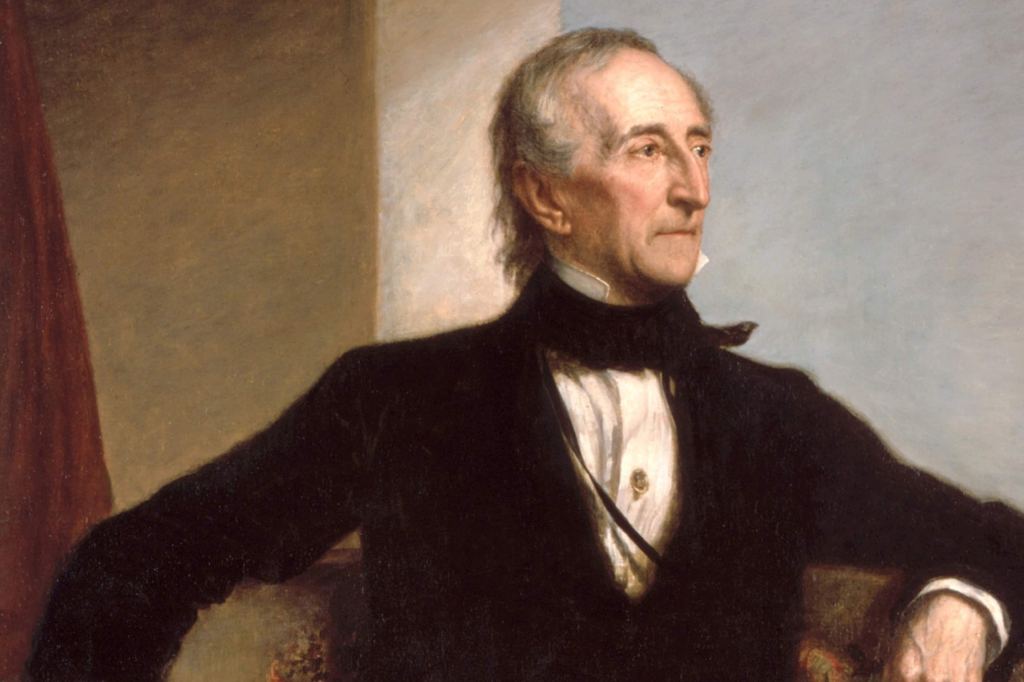
In the presidential election of 1836, Tyler would be a vice presidential nominee and again in 1840. This time he would be General William Henry Harrison’s running mate, a veteran of the War of 1812 and the war against a Native American coalition led by Tecumseh. Under the slogan “Tippecanoe and Tyler Too,” the Harrison-Tyler ticket would defeat incumbent President Martin Van Buren. Harrison would catch pneumonia after giving a two-hour inaugural address (the longest inaugural address in U.S. history) on a cold, rainy day without a coat or hat. He would die on April 4, 1841, after only serving 31 days in office.
The death of Harrison led to uncertainty over whether the vice president became the president or merely took on his duties. Tyler chose the former interpretation and took the oath of office. While he did sign into law many of the Whig-controlled Congress’s bills, he vetoed many others. He vetoed bills to create a national bank and raise tariff rates. Due to this, almost all of his cabinet resigned, he was expelled from the party and called “His Accidency.” He also vetoed a bill that would have prevented the President from authorizing the construction of new Coast Guard ships without the authorization of Congress. Congress would override this veto, the first time Congress overrode the president’s veto.
He had some foreign policy achievements despite the stalemate on domestic policy. He negotiated the Webster-Ashburton Treaty with Great Britain, which solved many border disputes, and the Treaty of Wanghia with Qing China, the first of the U.S.-imposed unequal treaties that gave the U.S. trading privileges with China. Tyler was a firm believer in manifest destiny and attempted to annex Texas, which had gained independence from Mexico.
He ran for re-election in 1844 but withdrew and endorsed Democrat James K. Polk. When the American Civil War began, Tyler would side with Virginia when it seceded. He would die on January 18, 1862, at the age of 71 and is the only president to not receive a state funeral, as he was still residing as a traitor in Virginia when he died.
James K. Polk (1845–1849)
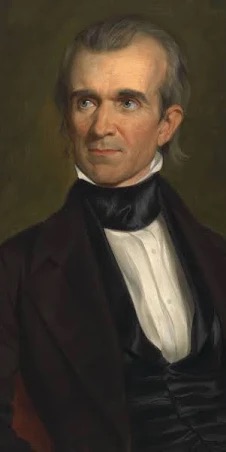
James Knox Polk was born on November 2, 1795, in a log cabin in North Carolina. His father, Samuel Polk, was a farmer, slave owner, and surveyor. While his father was a deist, meaning he viewed God as not intervening in the world, his mother was a devout Presbyterian and drilled her rigid orthodoxy into the young Polk. The Polks would move to Maury County, Tennessee, where they would dominate politics. Samuel Polk became a county judge, and the guests he would entertain at his home included future president Andrew Jackson. Polk would become a successful lawyer, which allowed him to be elected to the state legislature in 1823 and the House of Representatives in 1825. He would become a strong supporter of Jackson. He became Speaker of the House in 1835 and governor of Tennessee in 1839. He would lose reelection in 1841 and 1843.
He emerged as a dark horse candidate for the Democrats in the 1844 Presidential election. He was placed against Whig nominee Henry Clay. He pledged to serve only one term and annex Texas and the Oregon territory even if it meant war. He would narrowly defeat Clay. After tense negotiations, and the risk of war, Polk and Britain created the Oregon Treaty, which divided the Oregon territory along the 49th parallel. He annexed Texas, substantially reduced tariff rates, and created the Independent Treasury system, wherein the U.S. Treasury managed the money supply of the U.S. independent from a national bank.
After annexing Texas, Polk would also become interested in purchasing the California and New Mexico territory from Mexico and offered to purchase these territories for $30 million (equivalent to $1,012,392,857 in 2024 dollars). Mexico would refuse to sell the territory and did not recognize the southern border as being at the Rio Grande, the U.S.-recognized border, instead recognizing the Nueces River, creating a border dispute. In response, Polk placed General Zachary Taylor, a future president, on the disputed territory. Mexican troops demanded that Taylor retreat to the Nueces and, after being blockaded by Taylor, attacked Taylor’s troops. Polk asked Congress for a declaration of war, stating that Mexico had shed “American blood on American soil.” The declaration passed overwhelmingly in the House and 40–2 in the Senate.
The Mexican-American War would be fought for 1 year and 9 months, with Mexico being crushed by U.S. forces. The war would end with the Treaty of Guadalupe Hidalgo, which granted the U.S. the California and New Mexico territories, and Mexico was forced to recognize the Rio Grande as the border. Polk sought to establish territorial governments in California, New Mexico, and Oregon, but these proposals never got through Congress. He also wished to extend the line established by the Missouri Compromise that prohibited slavery north of it. This was also defeated.
After California asked for statehood, Congress would create the Compromise of 1850, which prohibited slavery in California and passed the Fugitive Slave Act, which made Northerners help slave catchers find escaped slaves. Polk would make good on his one-term pledge and endorsed Democrat Lewis Cass in the 1848 Presidential election (where Taylor would be the Whig nominee and victor). Polk would die on June 15, 1849, of cholera at the age of 53.
James A. Garfield (1881)
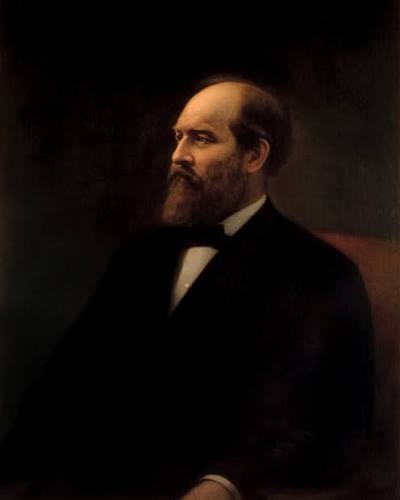
James Abram Garfield was born on November 19, 1831, in a log cabin in Ohio. His father, Abraham Garfield, died in 1834, and the young Garfield was raised in poverty. He graduated from Williams College in 1856 and became an attorney and a Protestant preacher. In 1859, Garfield was elected to the Ohio State Senate as a Republican, where he served until he joined the Union army in 1861. He became a major general and courageously served in the Battles of Shiloh and Chickamauga. In 1862, he was elected to represent Ohio in the House of Representatives.
In Congress, he aligned himself with the Radical Republicans, those who believed in the harsh treatment of the Confederacy and equality for freedmen. He would become a firm supporter of the gold standard and became known as a skilled orator. During Andrew Johnson’s presidency, Garfield voted to impeach him and voted for the 13th, 14th, and 15th Amendments, which were meant to support African-American rights.
In 1872, the Crédit Mobilier scandal, involving the corrupt financing of the transcontinental railroad, broke. The scandal involved Union Pacific Railroad officials secretly purchasing Crédit Mobilier to overcharge themselves for building the transcontinental railroad. One official, Congressman Oakes Ames, offered other congressmen Crédit Mobilier stock for well below what it was sold on the market. Among those named were Vice President Schuyler Colfax, Senator and Vice Presidential nominee Henry Wilson, Speaker James G. Blaine, and Garfield. Both Blaine and Garfield were quickly exonerated.
In 1875, the Democrats took control of the House. Garfield had hoped to retire in 1876, when his term expired, but ran for reelection to help his party. In 1876, it appeared the Republican presidential nominee Rutherford B. Hayes had lost, and Republicans, led by Garfield, organized a recount of the votes in Florida, South Carolina, and Louisiana. The three states were certified to have been won by Hayes. Democrats attempted to bring the election to Congress, but both parties reached a compromise where Hayes was declared the winner, but Reconstruction ended. In 1880, Garfield would be elected to the Senate.
In the 1880 Republican National Convention, Ohio Senator John Sherman was supported by Garfield for the presidency, while Blaine and former President Ulysses S. Grant also ran. At the time, the Republicans were divided between Stalwarts, who supported giving supporters federal jobs, and Half-Breeds, who supported a merit system. Roscoe Conkling, the leader of an influential political machine, gave an electrifying speech in support of Grant, while Garfield gave a calm speech asking delegates to vote with their conscience. The convention became deadlocked, and eventually many delegates, led by future president Benjamin Harrison, voted for Garfield, causing a stampede of votes for Garfield. Blaine and Sherman’s voters voted for Garfield, while Grant’s remained with him until the end. Garfield became the nominee, but in order to get the support of Grant’s embittered voters, Chester A. Arthur, a member of the Conkling machine, was made Vice President. Garfield would defeat Democrat Winfield Scott Hancock in a close race.
As president, he attempted to purge corruption from federal institutions like the Senate, Supreme Court, and Post Office. He advocated for protecting the civil rights of African-Americans. He would also appoint a Blaine supporter to the lucrative position of Collector of the Port of New York. This led to a political battle with Conkling that ended with his resignation and the death of his political career. On July 2, 1881, a deluded office seeker who had been refused political office shot Garfield in the back. Garfield would die from the wound on September 19, 1881, at the age of 49. Most professionals believe that Garfield would have survived if his doctor had used sterilized tools to find the bullet or simply left it alone. Arthur would succeed him and signed many of Garfield’s policies, such as the expansion of the U.S. Navy and the Pendleton Civil Service Reform Act.
William H. Taft (1909–1913)
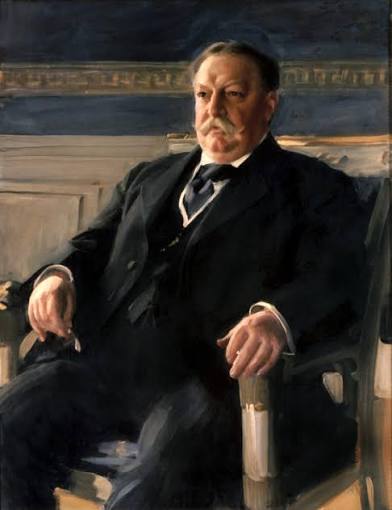
William Howard Taft was born on September 15, 1857, in Cincinnati, Ohio. His father, Alphonso Taft, was a judge, ambassador, and the Secretary of War and Attorney General under Grant. He graduated from Yale College in 1878, second in his class. He attended Cincinnati Law School and graduated in 1880 with a Bachelor of Laws. He easily passed the bar examination. In 1887, Taft was appointed as a judge on the Superior Court of Cincinnati.
In 1889, there was a vacant seat on the Supreme Court, and Taft pushed for President Benjamin Harrison to appoint him. Instead, Harrison appointed him as Solicitor General of the United States in 1890, a position that required him to represent the federal government in the Supreme Court and had been vacant for two months. He worked to eliminate the backlog of work while educating himself on federal law. Taft also introduced the policy of confession of error, where the government conceded a case in the Supreme Court it had won in a lower court but the solicitor general thought it should have lost. This policy is still in effect today. Taft would win 15 of the 18 cases he argued in the Supreme Court.
In 1892, Harrison would ask Taft to resign and appointed him to be a judge on the Court of Appeals for the Sixth Circuit, something Taft was happy to do. His duties would bring him to Ohio, Michigan, Kentucky, and Tennessee, and he would often side with workers over business owners. In 1896, Taft became dean and Professor of Property at Cincinnati Law School. In the 1896 Presidential election, Taft supported Republican William McKinley, due less to his opinion of the man and more to his views of Democrat William Jennings Bryan.
In 1900, McKinley placed Taft on a commission to organize a civilian government in the Philippines. At the time, Filipino rebels were fighting for independence from American rule. Taft and military governor Arthur MacArthur Jr. often clashed over Filipino self-rule, leading to MacArthur resigning and Taft becoming Governor-General. Taft treated the Filipinos as equals and advocated for self-rule. In 1901, McKinley was assassinated, and Theodore Roosevelt, a friend of Taft’s, became president. In 1902, Roosevelt wished to appoint Taft to the Supreme Court, but he refused it as he felt his work was not done yet. In 1903, Roosevelt asked Taft to be Secretary of War, and since this would mean he was responsible for the Philippines, he accepted. As Secretary of War, Taft helped organize the construction of the Panama Canal, attempted to help stabilize Cuba, and continued his work in the Philippines. Roosevelt appointed Taft as his successor. Taft would defeat William Jennings Bryan by a comfortable margin in the 1908 Presidential election.
As president, Taft supported high tariffs, continued Roosevelt’s efforts to weaken the power of trusts, and supported the rights of Catholics and immigrants, but scaled back Roosevelt’s conservationist legislation and intentionally did not appoint African Americans to federal jobs. In Latin America, Taft pursued a policy of promoting U.S. economic interests by exerting influence through private investment and loans. In 1910, the Mexican Revolution led to the essential collapse of the Mexican government. Mexican rebels would often cross the U.S. border to take guns and horses, something Taft sought to prevent by ordering the Army to guard the border.
In the 1912 presidential election, Roosevelt challenged Taft for reelection. Taft would get the Republican nomination. Roosevelt would form the Bull Moose Party and run anyway. Meanwhile, New Jersey Governor and Democrat Woodrow Wilson took many votes from the split in the Republican Party. Most of the Republican Party went to Roosevelt, and Wilson won the election. After leaving office, he became Professor of Law and Legal History at Yale Law School. In 1921, President Warren G. Harding appointed Taft to the position he had always wanted: Chief Justice of the Supreme Court. Due to his failing health, Taft resigned in 1930. He died from heart disease on March 8, 1930, at the age of 72.


 Tarmac Online
Leave a comment