
By: Ryan Manno ’27

Photo: NHL/NHLI via NHL.com
At a time when most franchises chase draft lotteries and long-term rebuilds, the Pittsburgh Penguins have done something almost unheard of in the modern NHL: they’ve resurrected a legitimate contender after nearly everyone had written them off.
Entering the season, the outlook was clear. Pittsburgh had missed the playoffs three straight years, a reality that fueled constant speculation about the future of the franchise’s iconic core: Sidney Crosby, Evgeni Malkin, and Kris Letang. National expectations reflected that. ESPN ranked the Penguins 30th out of 32 teams in their opening season power rankings, grouping them with clubs expected to sell assets and pivot toward the draft lottery.
Instead, Pittsburgh pivoted toward relevance.
For nearly two decades, the Penguins have been defined by consistent excellence. Championships, playoff runs, and elite star power became the standard in the Steel City. But no one beats Father Time. Trade rumors followed Crosby. Malkin’s consistency was questioned. Letang’s workload was scrutinized. The assumption was simple: the window had finally closed.
At least that’s what the public thought.
What followed wasn’t a teardown, it was a recalibration built on simple low risk high reward trades to help “rebuild on the fly”.
The first signal that this season would be different came before a puck was dropped. Pittsburgh made the difficult decision to move on from Mike Sullivan and hand the bench to Dan Muse, a coaching change that marked a clear shift in culture. Muse brought a faster pace, clearer structure, and an emphasis on accountability throughout the lineup, a refresh the Penguins were missing. His willingness to trust all four lines and demand defensive detail allowed veterans to thrive in defined roles while opening the door for younger players to earn real responsibility. From the get go, the Penguins looked more connected, disciplined and prepared, a reflection of a preseason decision that reshaped the team’s identity.

Photo: WTAE via Hearst Television
Rather than chasing big name players, Pittsburgh targeted fit. Anthony Mantha arrived with something to prove and brought physicality and secondary scoring that immediately translated. Justin Brazeau exceeded expectations as a size and skill forward who found ways to contribute offensively and get in front of the net while holding his own in heavier minutes. On the blue line, Parker Wotherspoon quietly became one of the most important depth additions of the season, providing reliable, mistake free minutes that stabilized the blue line and complemented Karlsson flawlessly.
The most consequential roster change, however, came midseason.
Pittsburgh made the bold decision to move on from their 2 time All Star Tristan Jarry, sending the longtime goaltender to the Edmonton Oilers in a deal that brought back Stuart Skinner, Brett Kulak and a 2029 2nd round pick. The trade signaled not only a roster switch, but also a psychological switch. Skinner stepped into a tandem with young netminder Arturs Šilovs, who provided steadier goaltending, something the Penguins had lacked in recent seasons. Kulak was later flipped for young and speedy defenseman Samuel Girard and a 2028 2nd round pick, turning the Jarry deal into both immediate roster support and long term flexibility.

Photo: Pittsburgh Post‑Gazette / via Post‑Gazette Sports
Pittsburgh also added scoring depth with the acquisition of winger Yegor Chinakhov, a low risk, upside driven move that reinforced the middle six and further brought youth into the offense. Rather than relying solely on the stars, the Penguins built layers.
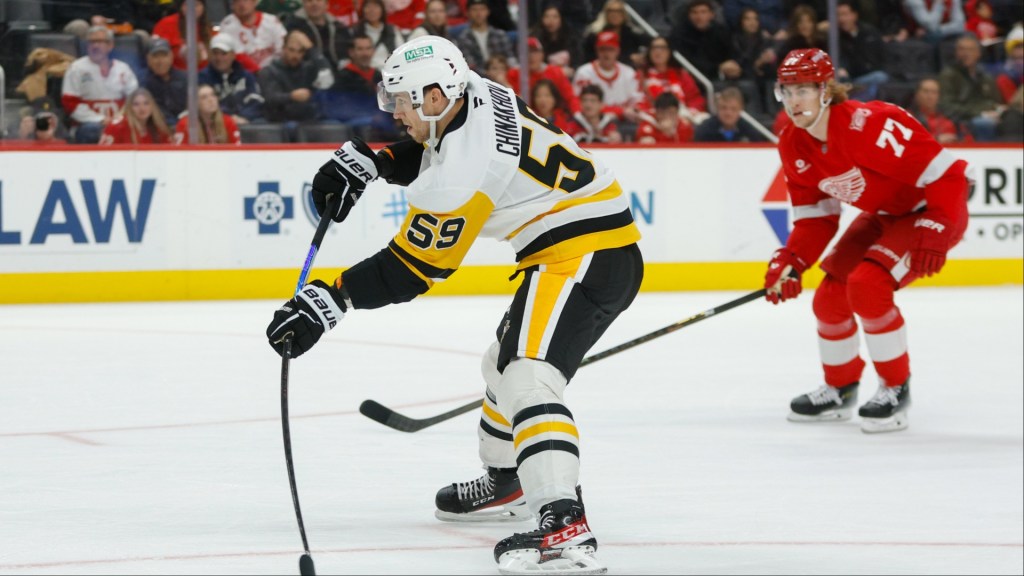
Photo: SportsNet Pittsburgh
And the stars responded.
Crosby, in his 21st season overall and 19th season captaining Pittsburgh, has once again hovered above a point per game pace, controlling games through detail, competitiveness, and elite two way play. Malkin has been one of the league’s most surprising performers, posting 44 points in 41 games and skating with a confidence and explosiveness reminiscent of his prime. A major reason for that resurgence has been the emergence of Tommy Novak as a reliable winger alongside him, a player whose pace and awareness have allowed Malkin to attack offensively without carrying the line alone.
On the back end, Erik Karlsson has tightened his defensive play and found balance within Head Coach Dan Muse’ structure, while Letang continues to anchor difficult matchups and heavy minutes.
What truly separates this Penguins team from recent years, though, is its strong depth on both sides of the puck.
For the first time in years, the fourth line has become a weapon rather than a liability. In fact, it has been one of the most effective fourth lines Pittsburgh has iced during the 87-71-58 era, consistently winning shifts, applying pressure, and allowing the coaching staff to roll four lines with confidence. That balance has worn opponents down and fundamentally changed how Pittsburgh manages games. Muse has been able to disperse ice time generously, with skaters rarely playing below ten minutes per game.
Then there’s the season’s most improbable storyline.
Ben Kindel is just 18 years old, and he wasn’t a top three draft pick. In today’s NHL, that combination almost always means another few years of development in the AHL or other developmental leagues. Instead, Kindel forced his way directly into the lineup and contributed immediately. His scoring touch and ability to keep up at NHL pace have made his rise exceptionally rare, placing him firmly in Calder Trophy conversations and underscoring the Penguins’ renewed development culture.

Photo: Pittsburgh Penguins/NHLI via NHL.com
Nearly every regular skater on the roster has found the scoresheet this season, a testament to a lineup built on balance rather than dependence. From top end superstars to depth contributors, Pittsburgh has created offense by committee while maintaining structure and accountability.
Just as important as what has happened on the ice is how Pittsburgh has positioned itself off it. Since Kyle Dubas took control of hockey operations, asset management has become a quiet competitive advantage. Rather than sacrificing the future for short term relevance, Dubas has consistently extracted maximum value from every move, turning roster turnover into long term leverage. The Jarry trade alone evolved into goaltending stability and future capital, and more flips only strengthened the return. As a result, the Penguins now possess a surplus of draft picks, particularly in the first three rounds over the next three drafts, giving the organization rare flexibility for a team that is still competing at a high level. It’s a foundation that ensures this resurgence isn’t just for the present.

Photo: Hockey Canada/NHLI via HockeyCanada.ca
Just months ago, the Penguins were being discussed as a potential lottery team, a franchise potentially chasing the next generational prospect. Now, they’re firmly in the playoff hunt and no contender wants to face a deep, structured, veteran led Pittsburgh team in a seven game series.
This isn’t a nostalgia act. This is a calculated resurgence driven by smart trades, targeted acquisitions, internal belief, and a refusal to accept the league’s assumptions.
In a season filled with surprises, none has been bigger or more convincing than the Pittsburgh Penguins.
 Tarmac Online
Leave a comment